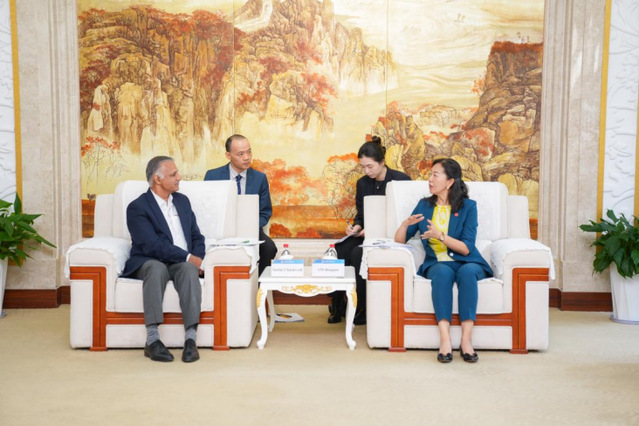
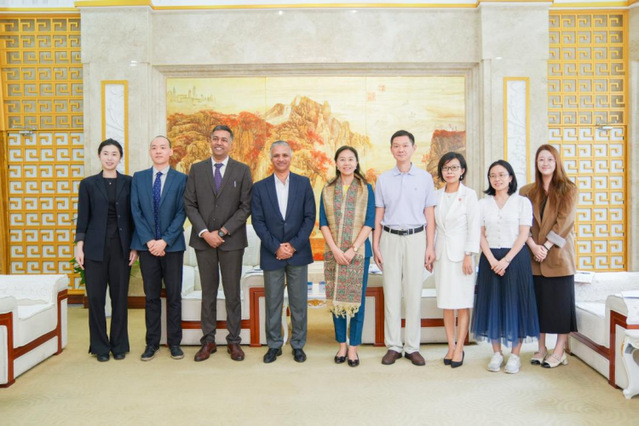
On September 16, Professor Sachin Chaturvedi, Vice Chancellor of Nalanda University, Bihar, led a delegation to visit the Songjiang Campus of Shanghai International Studies University (SISU). Chair of the University Council Yin Dongmei met with the guests, and the two sides held in-depth talks on topics including classical literature research, cultural exchanges, and faculty and student exchange programs.
Nalanda University is an international research university located in Rajgir, Bihar, India. Rooted in the historical legacy of Nalanda, the ancient Indian center of Buddhist learning, it was established and rebuilt in 2010 pursuant to legislation enacted by the Indian Parliament. Adhering to the principles of interdisciplinary research and international cooperation, the university focuses on talent cultivation and academic research in fields such as historical studies, Buddhist studies and philosophy, ecology and the environment, international relations, and sustainable development. It is committed to carrying forward the spirit of mutual learning among Asian civilizations and advancing research on area cooperation and global governance.
Yin extended a warm welcome to Chaturvedi and his delegation, briefly introducing the university's latest progress in disciplinary development, talent cultivation, research innovation, and international cooperation, with a focus on its achievements in the study of classical civilizations and area studies. She noted that SISU has long been dedicated to classical civilization research and has built up solid academic expertise in this field. In recent years, the university has striven to develop an integrated research frameworkof five elements —languages, literature, cultural relics, culture, and civilization, establishing academic cooperation platforms with multiple countries to facilitate mutual learning among civilizations, actively conveying Chinese academic voices in the global knowledge system, and contributing to the construction of a philosophy and social science knowledge system with Chinese characteristics and independence. In the field of area studies, the university attaches great importance to research on countries in the Global South, with India as a representative case, and has produced a number of valuable outputs and contributions. She emphasized that the exchanges between the two great civilizations of China and India boast a long history and profound heritage, and that amid the current profound evolution of the international landscape, the two sides should further deepen youth exchanges, educational collaboration, and academic discussion. She expressed the hope of expanding practical cooperation with Indian universities and think tanks, including personnel visits and joint research.
Chaturvedi expressed gratitude for SISU's warm reception and spoke highly of the university's fruitful achievements in Indian studies and in promoting cultural exchanges. He noted that the two sides enjoy broad opportunities for cooperation in cultural exchanges as well as in area and international relations studies, and that the systematic enabling power of artificial intelligence should be fully harnessed to facilitate interdisciplinary integration and innovation between the natural and social sciences, while also giving high priority to issues related to sustainable development. He anticipates the further deepening faculty exchanges, talent cultivation, and youth exchanges with SISU in areas such as global governance and mutual learning among civilizations. At the same time, building on the existing research foundation of the SISU Center for Indian Studies and its exchange networks with India, both sides will continue to work together to promote China-India academic exchanges and enhance mutual understanding between the two countries.
Rohit Koganti, Cultural Consul of the Indian Consulate General in Shanghai, accompanied the delegation on the visit. Officials from the International Office, the School of International Relations and Public Affairs (SIRPA), the Center for Indian Studies, and the School of Asian and African Studies (SAAS) attended the meeting. After the meeting, Chaturvedi and his delegation visited the Center for Indian Studies, where they held a discussion with its faculty and students on topics including global climate change and China-India youth exchanges.