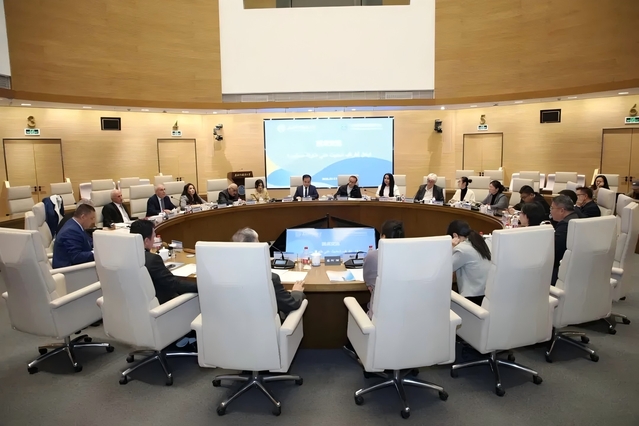
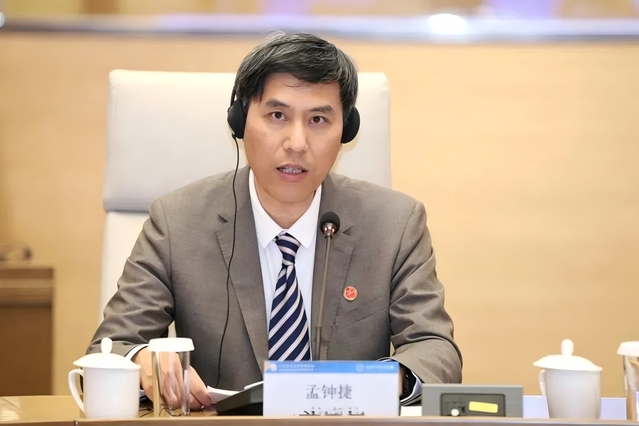
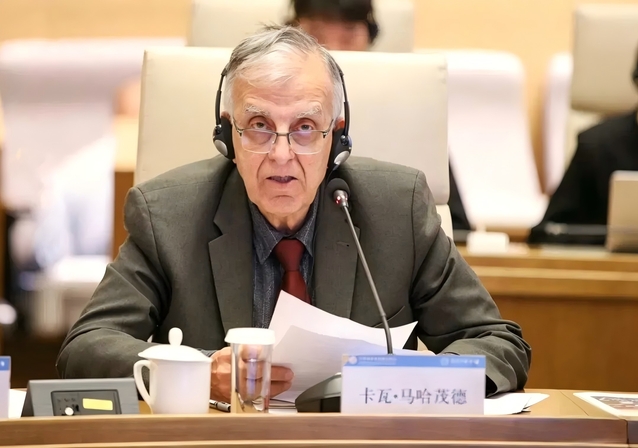
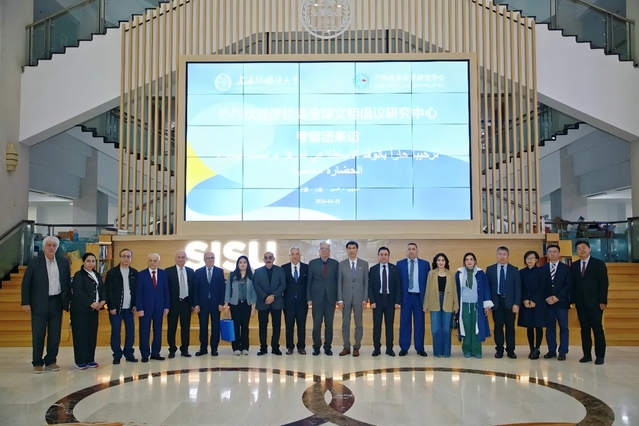
On April 13, a delegation from the Iraqi Global Civilization Initiative Research Center, led by its Chairman and former Secretary-General of the Kurdistan Communist Party, Kawa Mahmoud, visited the China-Arab Research Center on Reform and Development (hereafter referred to as “the Center”). Representatives from political parties, think tanks and academic institutions from Iraq, Palestine, Syria, Jordan, Lebanon and other countries participated in a roundtable discussion with the Center under the theme of “Exchanges and Mutual Learning Between Chinese and Arab Civilizations.” Meng Zhongjie, President of SISU, as well as Executive Director of the Center, attended the event and delivered a speech.
Meng extended a warm welcome to the delegation on behalf of SISU. He said that President Xi Jinping has put forward the Global Civilization Initiative, which advocates viewing different civilizations from a broad and inclusive perspective and provides a Chinese approach to addressing common global challenges. He emphasized that exchanges and mutual learning between Chinese and Arab civilizations have a long history, with both sides sharing highly compatible values and aspirations. He said the Iraqi Global Civilization Initiative Research Center, as one of the earliest institutions in the Middle East focusing on the Initiative, has built an important platform for promoting academic and cultural exchanges. He added that SISU, leveraging its established strength in multilingual education, has developed a distinctive system of Middle East studies through coordinated efforts across various think tank platforms. Noting that this year marks the 70th anniversary of the establishment of diplomatic relations between China and Arab countries, he expressed the university’s willingness to further deepen cooperation with Arab universities and think tanks, enhance consensus, and contribute wisdom and strength to building a China-Arab community with a shared future.
Kawa Mahmoud expressed his gratitude for the warm reception by SISU. He said that exchanges and mutual learning among civilizations play an irreplaceable role in promoting peace and stability. He emphasized that the “four joint advocacies” proposed by President Xi Jinping in the Global Civilization Initiative fully respect the diversity of civilizations while seeking common ground, providing important inspiration for countries to explore development paths suited to their own national conditions. He noted that the Initiative provides a practical pathway toward building a more inclusive international order. He said the establishment of the Iraqi Global Civilization Initiative Research Center conforms to the prevailing trend of peace and development. He also expressed willingness to further strengthen exchanges and cooperation with Chinese universities and think tanks, strengthen academic dialogue and capacity building, and jointly promote exchanges and mutual learning between Arab and Chinese civilizations.
Wang Guangda, Secretary-General of the Center, delivered a keynote lecture, systematically elaborating on the history of exchanges and mutual learning between Chinese and Arab civilizations, particularly the exchanges and cooperation in various fields between Shanghai and Arab countries in recent years. He said that through the Silk Road, China and the Arab world have steadily strengthened their ties, expanding exchanges from trade to broader cooperation and shaping a non-Western model based on equality, mutual respect, and mutual benefit. This has provided both material and cultural support for building a China-Arab community with a shared future.
During the roundtable session, participants engaged in in-depth discussions on topics including the governance experience of the Communist Party of China, the Global Civilization Initiative, and exchanges and mutual learning mutual learning between Chinese and Arab civilizations.
The event was chaired by Mao Xiaohong, Director of the Office of International Cooperation and Exchange. Representatives from the International Department of the CPC Central Committee, the Foreign Affairs Office of the Shanghai Municipal People’s Government, as well as relevant departments, schools, and research institutes of SISU, attended the event.