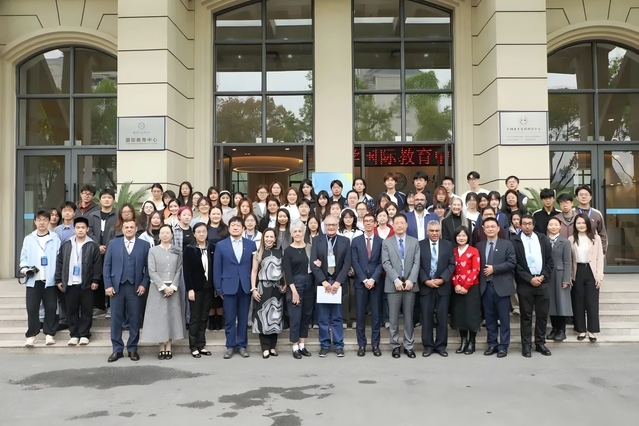
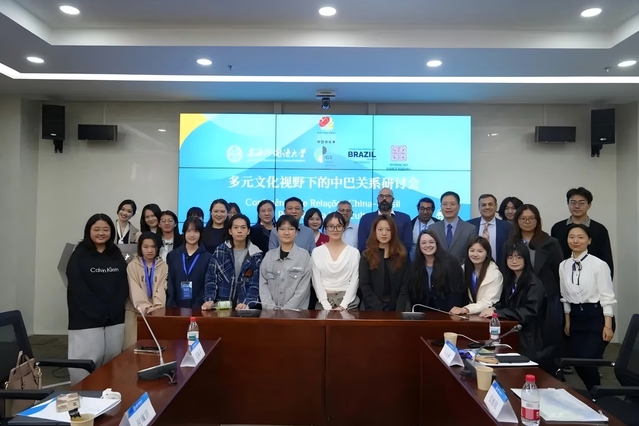
On April 17, 2026, the “Seminar on China–Brazil Relations from a Multicultural Perspective” was successfully held at the Songjiang campus of Shanghai International Studies University (SISU).
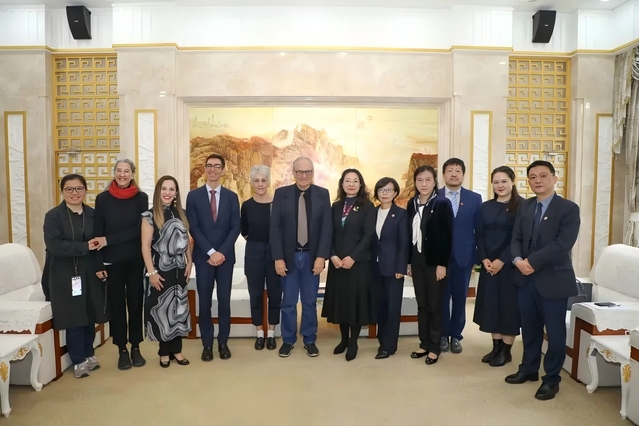
Before the seminar, Wang Xin, Vice President of SISU and Dean of the School of European and Latin American Studies, met at the International Education Center with Brazil’s Deputy Consul General in Shanghai, Lucas Lima, José Ronaldo Alves da Cunha, President of the Darcy Ribeiro Foundation, and other members of the delegation. Wang introduced SISU’s development history and educational features, noting that SISU has established friendly cooperative relationships with universities, research institutions, and international organizations in many countries, including Brazil. She expressed SISU’s willingness to leverage its unique strengths, actively support national strategies, and contribute to deepening China–Brazil cultural exchange and bilateral friendship.
Deputy Consul General Lucas Lima thanked SISU for its warm hospitality. He highly praised SISU’s achievements in teaching, research, and intercultural promotion, and hoped that this event would serve as an important link to further support exchanges between SISU and Brazilian universities. Cunha noted that the visit was highly meaningful, sharing the hope that the translation of classic works of Brazilian literature by scholars at SISU would help the Chinese public gain a fuller understanding of Brazilian culture, while deepening cooperation with China and SISU and exploring new opportunities for collaboration.
During the opening ceremony, Vice President Wang, Deputy Consul General Lucas Lima, Deputy Dean Yang Ming of the School of European and Latin American Studies, and President Cunha of the Darcy Ribeiro Foundation delivered remarks. They all emphasized that, as an important part of the 2026 China–Brazil Cultural Year celebrations, the seminar built a solid bridge for civilizational exchange and mutual learning between the two countries and played a significant role in advancing China–Brazil multicultural dialogue.
President Cunha and Vice President Gisele Jacon of the Darcy Ribeiro Foundation, Associate Professor Yan Qiaorong from Communication University of China, and Professor Xu Yixing from SISU’s School of European and Latin American Studies gave thematic presentations. They discussed topics including the life and contributions of the 20th-century Brazilian thinker Darcy Ribeiro, the significance of his classic The Brazilian People: Formation and Meaning and the challenges in translating it, the development and current status of SISU’s Portuguese program, and the translation and publication of notable China–Brazil works. In the thematic discussion session, experts and scholars from Lanzhou University, Zhejiang International Studies University, Shanghai Institutes for International Studies, Tongji University, Shanghai University, Beijing International Studies University, and other institutions gathered. They engaged in broad and in-depth exchanges on topics including green cultural communication, dialogue and cooperation between civilizations, innovation in people-to-people exchange, progress in Brazilian studies of China, the construction of China’s international discourse, and global dissemination of Chinese culture. Participants shared diverse views and reached consensus, offering multiple ideas and recommendations to promote China–Brazil cultural and academic cooperation.
In 2024, China and Brazil elevated their bilateral relationship to the level of “Building a China–Brazil Community with a Shared Future for a More Just World and a Sustainable Planet.” Holding the 2026 China–Brazil Cultural Year is a key outcome of the consensus reached by the two heads of state on strengthening the construction of this community. The seminar is both a concrete practice by SISU in serving China–Brazil cultural exchange and supporting the community’s construction, and an important achievement in the University’s efforts to transform its education system and build a five-dimensional system – languages, literature, cultural relics, culture, and civilization.
Representatives from the Office of International Cooperation and Exchange and the School of European and Latin American Studies participated in the seminar.